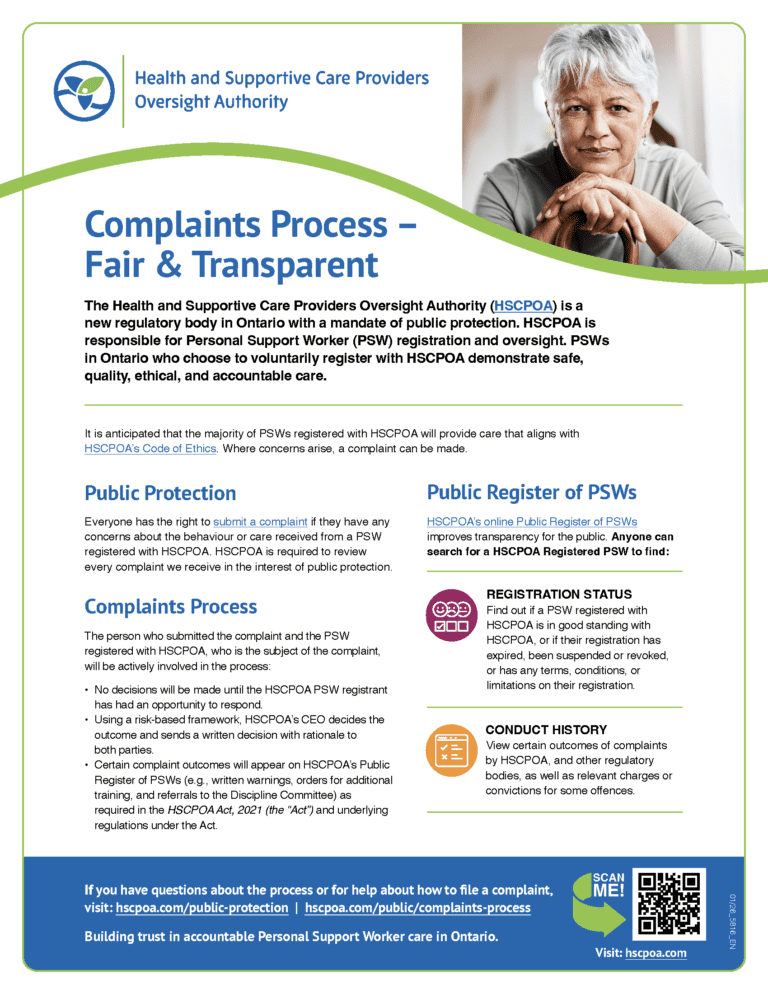

Complaints Process
The creation of HSCPOA supports public protection by ensuring Personal Support Workers (PSWs) registered with HSCPOA (HSCPOA registrants) provide competent, safe, quality, ethical and accountable health and supportive care services. Every HSCPOA registrant must comply with the requirements set out in HSCPOA’s Code of Ethics Regulation, under the Health and Supportive Care Providers Oversight Authority Act, 2021 (the “Act”) which lays the foundation for HSCPOA’s complaints process.
HSCPOA is confident that most PSWs registered with HSCPOA will provide care that aligns with our Code, and most will never be the subject of a complaint. However, if a recipient of health and supportive care services has concerns with the care they received from a HSCPOA registrant, they have the right to submit a complaint. HSCPOA is required to review every complaint we receive in the interest of public protection.
We recognize that there is apprehension from some PSWs/HSCPOA registrants about complaints, but despite our primary mandate being public protection, the fact that a complaint is received does not necessarily mean that there will be a decision that negatively impacts the HSCPOA registrant. In most cases, except where there is a high risk of harm to the public, such as sexual abuse etc., HSCPOA registrants can continue to provide health and supportive care services without restrictions while the complaint is investigated, and even after there is an outcome.
Below are answers to some commonly asked questions about HSCPOA’s complaints process.
Within 14 days of receipt of a complaint, HSCPOA will send you an exact copy of the complaint with a detailed fact sheet explaining the process in clear language. HSCPOA will highlight the applicable sections of the HSCPOA Code of Ethics that are relevant to the concerns in the complaint, and you will have 30 days to provide a written response. During the complaints process, you will also have an opportunity to provide supporting documentation, such as photographs, emails, or documents for HSCPOA to consider.
It is important to note that a decision will not be made about the complaint, until HSCPOA has received your response, or until after you have been given several opportunities to do so, within a prescribed period of time. Following that, HSCPOA’s CEO may ask for additional information or clarification from you and/or the complainant (individual who submitted the complaint). Once all relevant information is obtained, HSCPOA will issue a written decision, with rationale, to you and the complainant.
Yes, section 43(2)(b) of the Act states that you are required to fully cooperate with any requests for information received from the CEO with regards to complaints.
You do not need to have a lawyer, but it is your choice as to whether you obtain legal representation. You may also choose to have your association or union representative assist you with your response or engage with HSCPOA on your behalf. Although HSCPOA will provide you with details about the complaints process, we cannot give you or the complainant advice about what you should or should not do. HSCPOA’s focus is to oversee a fair, impartial, and transparent complaints process that promotes public protection.
HSCPOA’s CEO reviews all complaints that are received and makes a decision using a risk-based approach.
HSCPOA’s response will be measured and proportionate to the concerns outlined in the complaint, and whenever appropriate, HSCPOA’s focus will be remediation, such as issuing a letter of advice with guidance, or meeting with a PSW expert from HSCPOA’s PSW Advisory Committee to reflect on the issues in the complaint. For lower risk concerns, HSCPOA will attempt to resolve the issues between you and the complainant through mediation.
Under section 44 of the Act, the CEO may choose any of the following actions:
- take no action;
- attempt to mediate or resolve the concerns;
- provide you with written advice;
- issue a written warning to you;
- require you to take educational courses or training;
- impose conditions on your certificate of registration; or
- refer contraventions of the Code of Ethics to the Discipline Committee (usually reserved for the most serious concerns, such as various forms of abuse, or boundary violations etc.); or
- take any other actions they consider appropriate.
HSCPOA follows due process and the principles of fundamental justice before HSCPOA’s CEO decides the outcome of a complaint. What this means is that before any decisions are made, a thorough investigation is conducted, which includes giving you an opportunity to provide a response to the concerns raised in the complaint. If you wish to appeal the CEO’s complaint decision, you can apply to the Ontario Divisional Court for a judicial review.
To support HSCPOA’s mandate of public protection, certain complaint outcomes may be posted under your HSCPOA registrant profile on our Public Register of PSWs, pursuant to the Register Regulation under the Act. Those outcomes include any written warnings, orders for educational courses or training, conditions on your certificate of registration, or referrals to the Discipline Committee.
There are various factors that could affect how long an investigation takes. No specific timeline is required under the HSCPOA Act or its regulations; however, HSCPOA strives to complete investigations as quickly as possible. Factors that can affect the length of an investigation include the following: how quickly you, the complainant, or another third party responds to HSCPOA’s request for a response or provides documents requested by HSCPOA, and witness(es) availability, if applicable. HSCPOA recognizes that having a complaint made about you may be unsettling, and that naturally you will be eagerly awaiting the outcome; however, conducting a thorough, fair and transparent investigation takes time. You will be provided with periodic updates as the investigation progresses, but if you would like an update on the status at any time, please reach out and we would be happy to assist.